Block-based reservation rates
How can I create reservation rates where the hourly rates get cheaper the longer the reservation lasts?
Written By Zemtu
Last updated 5 days ago
In addition to the standard reservation rates (Overview - reservation rates ), there are also block-based reservation rates. Depending on the duration of the reservation, different blocks are applied.
You can find it here:
Zemtu Billing administration → Block based reservation rates
/admin/billing/blockbasedtariff/
Block Selection Strategies
The block selection setting controls how the configured time blocks are applied to the reservation duration. Three algorithms are available.
The three strategies
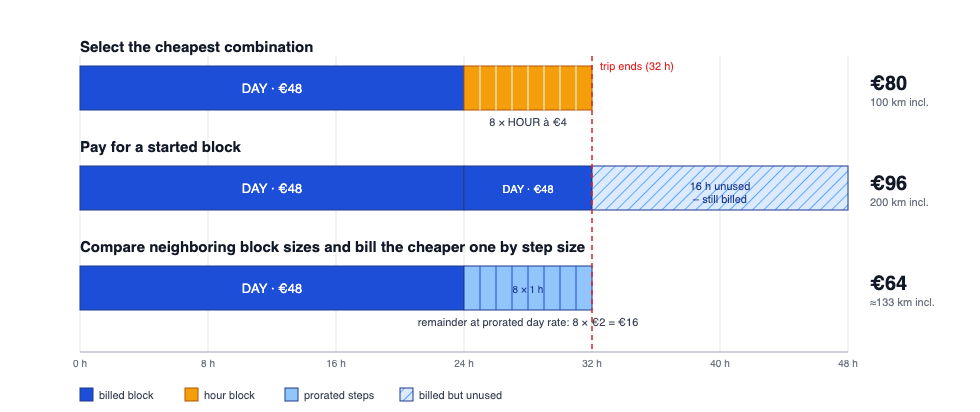
"Select the cheapest combination"
The algorithm tries trains of blocks of mixed sizes and picks the cheapest combination. Every block in the winning train is billed in full; the "Minimum time block fragment size" is ignored.
"Pay for a started block"
Exactly one block size is repeated for the whole trip. Every started block is billed in full, so leftover time always rounds up to a complete block. The "Minimum time block fragment size" is ignored.
"Compare neighboring block sizes and bill the cheaper one by step size"
Like "Pay for a started block", one block size is committed to – but only from the at most two thresholds adjacent to the trip duration (ties go to the smaller block). The difference: completed thresholds are billed as whole blocks, while the remaining time is priced in slices of the "Minimum time block fragment size" at the block's prorated rate. The included distance grows proportionally with each charged step.
Side-by-side example
Reservation rate with two blocks:
Trip: 32 hours
When to use which
Good to know
The "Minimum time block fragment size" only takes effect with "Compare neighboring block sizes and bill the cheaper one by step size" – the other two strategies ignore the field.
The strategy only decides the time fee. Booking fee, distance fees beyond the included allowance, late-return and minimum fees are calculated afterwards as usual.
Step-size can express pricing that blocks alone cannot – e.g. "€48/day + €2 per additional started hour" without a standalone hourly rate, or prorated included kilometers.
Free distance per commenced time unit
Typical use case: "150 free miles per day".
In addition to the per-block included distance, a block-based reservation rate can include a free distance X per commenced time unit Y. Set both fields in the reservation rate’s Free distance section:
Free distance = X, in your organization's distance unit (km or mi), and Free distance time unit = Y (e.g. 24 hours).
For each commenced time unit, the included free distance is added: every commenced time unit counts once, so one minute past a full time unit already counts as another unit.
Good to know
The free distance is added to the included distance of the applied time blocks. E.g. free distance 150 plus a block including 100 gives 250 included in total.
It is independent of the block selection strategy and only affects the included distance — the time fee is unchanged. Booking fee, distance beyond the total included distance, late-return and minimum fees are calculated afterwards as usual.
The distance unit follows your organization (km or mi). The included distance also shows up in the cost calculators.
Typical use case: "150 free miles per day". Do not combine this with a general free-mileage distance block (0–X with fee 0) for the same allowance — both would count, and a 10 h reservation would get 300 instead of 150 free miles.
Was this helpful?
Still need help? Share an idea